Account Takeover Prevention
Account takeover (ATO) attacks can severely damage both customer trust and business operations. The NordStellar Dark Web API enables powerful protection mechanisms to help prevent unauthorized access to user accounts by leveraging breach intelligence and zero-knowledge privacy techniques.
The Challenge
Account takeover attacks are one of the most common and damaging threats organizations face today:
- 22% of data breaches involve stolen credentials (Verizon DBIR)
- ATO attacks increased by over 300% in the past two years
- The average cost of a successful account takeover is $290 per compromised account
Attackers typically exploit:
- Password reuse across multiple services
- Stolen credentials from third-party breaches
- Password variations that follow predictable patterns
- Stolen session cookies from malware infections
Zero-Knowledge Password Protection
Our API is built on the principles of k-anonymity, ensuring the strictest privacy for your users. You can leverage our solution without ever sharing any sensitive user information with us.
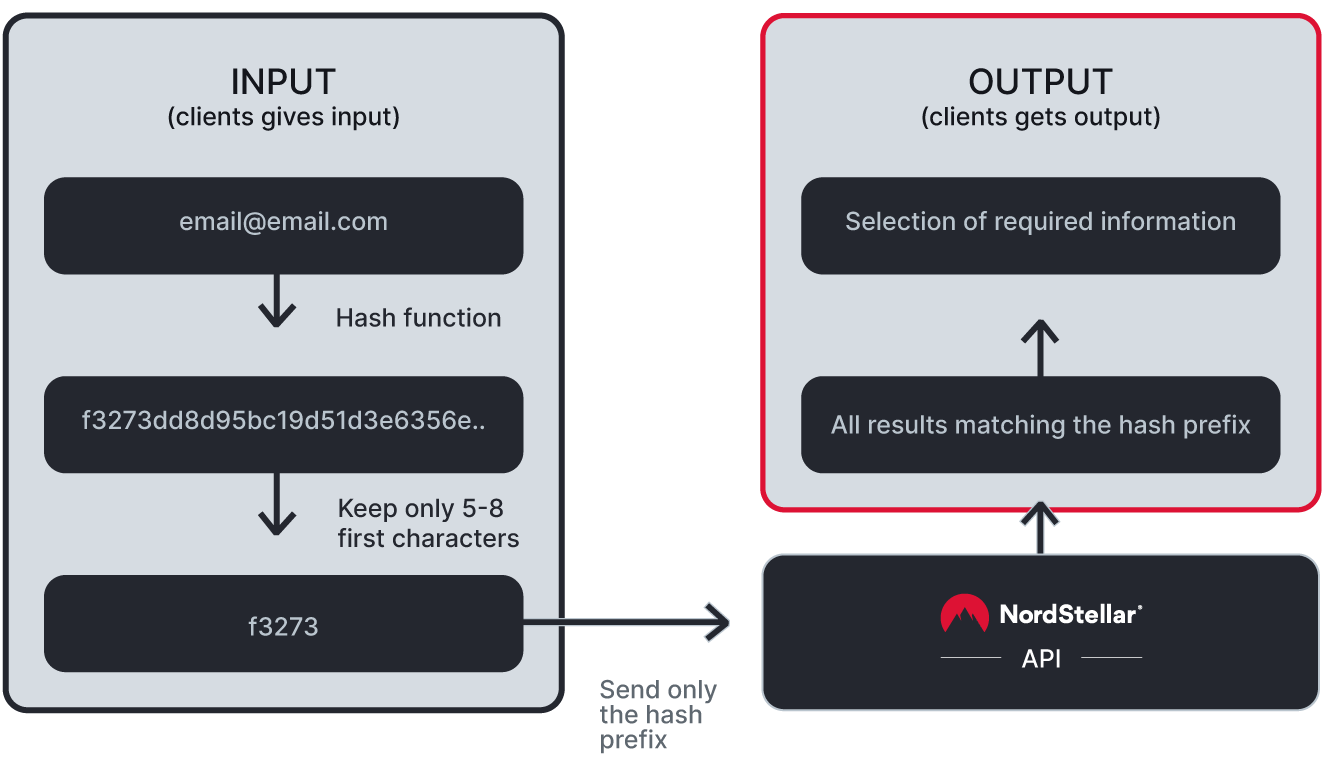
How K-Anonymity Works
To leverage our API for proactive breach prevention, follow these steps:
-
Hash your assets: Utilize the SHA256 hashing algorithm to hash each asset you wish to monitor, such as email addresses, passwords, or credit card numbers. This creates a unique, irreversible string of characters that protects the original data.
-
Extract the relevant portion of the hash: Depending on the asset type, extract a specific number of characters from the beginning of the hashed string. This creates a hash prefix used for API lookups.
- Passwords: Use the first 6 characters for breached password search.
- Email addresses: Use the first 8 characters for breached passwords or cookies associated with the email address.
- Phone numbers: Use the first 8 characters for breached passwords or cookies associated with the phone number.
-
Utilize the API: Once you have the hash prefix, submit it to our API for the desired search. We utilize k-anonymity to search without revealing any of your original data. You will receive a response indicating whether the provided hash (or the corresponding asset) is associated with a known breach.
Login Security Enhancement
Breached Password Detection
Integrate the zero-knowledge password API into your login and registration flows to:
- Block the use of known compromised passwords during account creation
- Warn users when they attempt to log in with compromised credentials
- Enforce password changes when breaches affecting the user are detected
Similar Password Detection
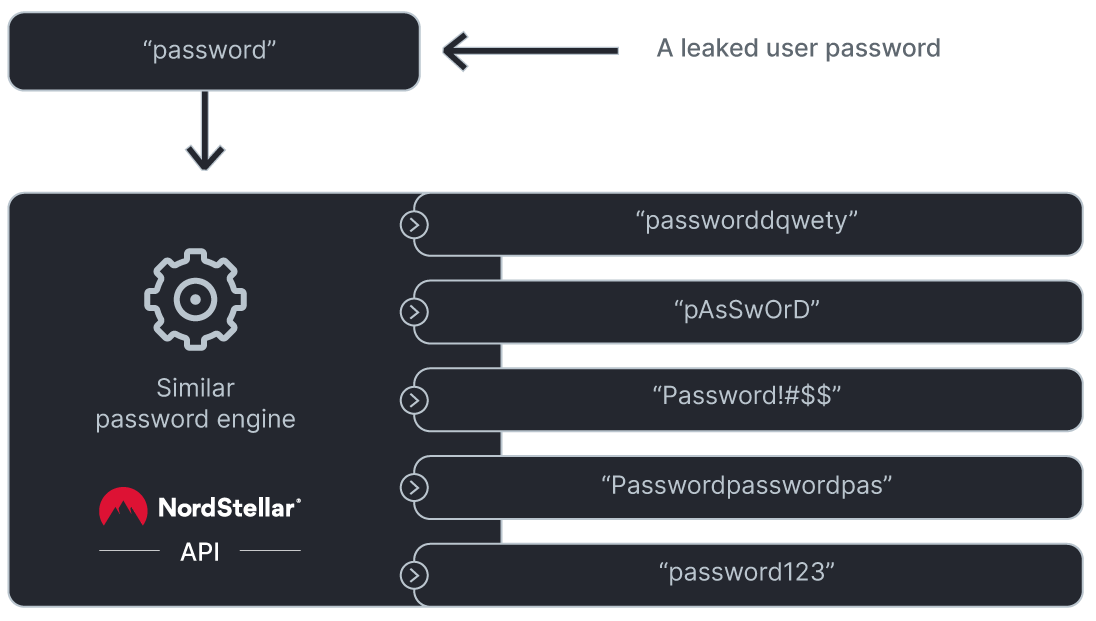
While reusing passwords with minor modifications is a common practice, it leaves users vulnerable. We understand the temptation to simply add a number or symbol to an existing password, but this approach offers minimal security improvement.
To combat this, we offer a solution that goes beyond basic checks for identical leaked passwords. We leverage our similar password engine to analyze potential variations, considering common modification patterns like adding numbers, symbols, or capitalizing letters. This allows us to identify even slightly modified versions of leaked passwords, significantly enhancing your defenses against account takeover attempts.
The techniques we use for generating password variations are based on common password-cracking methods, which we improved and extensively benchmarked for the best results.
Risk-Based Authentication
Use breach intelligence to implement risk-based authentication:
- Assign higher risk scores to login attempts using compromised credentials
- Implement additional verification steps for high-risk logins
- Apply security measures proportional to the detected risk level
Session Security
Cookie Protection
Protect your users from session hijacking attacks:
- Check session cookies against our zero-knowledge cookie endpoints
- Detect compromised session tokens that may have been stolen via malware
- Invalidate compromised sessions and force re-authentication
Credential Stuffing Prevention
Strengthen your defenses against automated attack patterns:
- Monitor for multiple failed login attempts using known leaked credential pairs
- Implement CAPTCHA or rate limiting for suspected credential stuffing attacks
- Analyze login patterns for indicators of automated credential stuffing tools
Account Recovery Security
Secure your account recovery flows with breach intelligence:
- Apply stricter verification for recovery attempts on accounts with breach history
- Use alternative channels for recovery communications if email has been compromised
- Notify account owners through secondary channels when recovery is attempted
Implementation Strategies
Login Form Integration
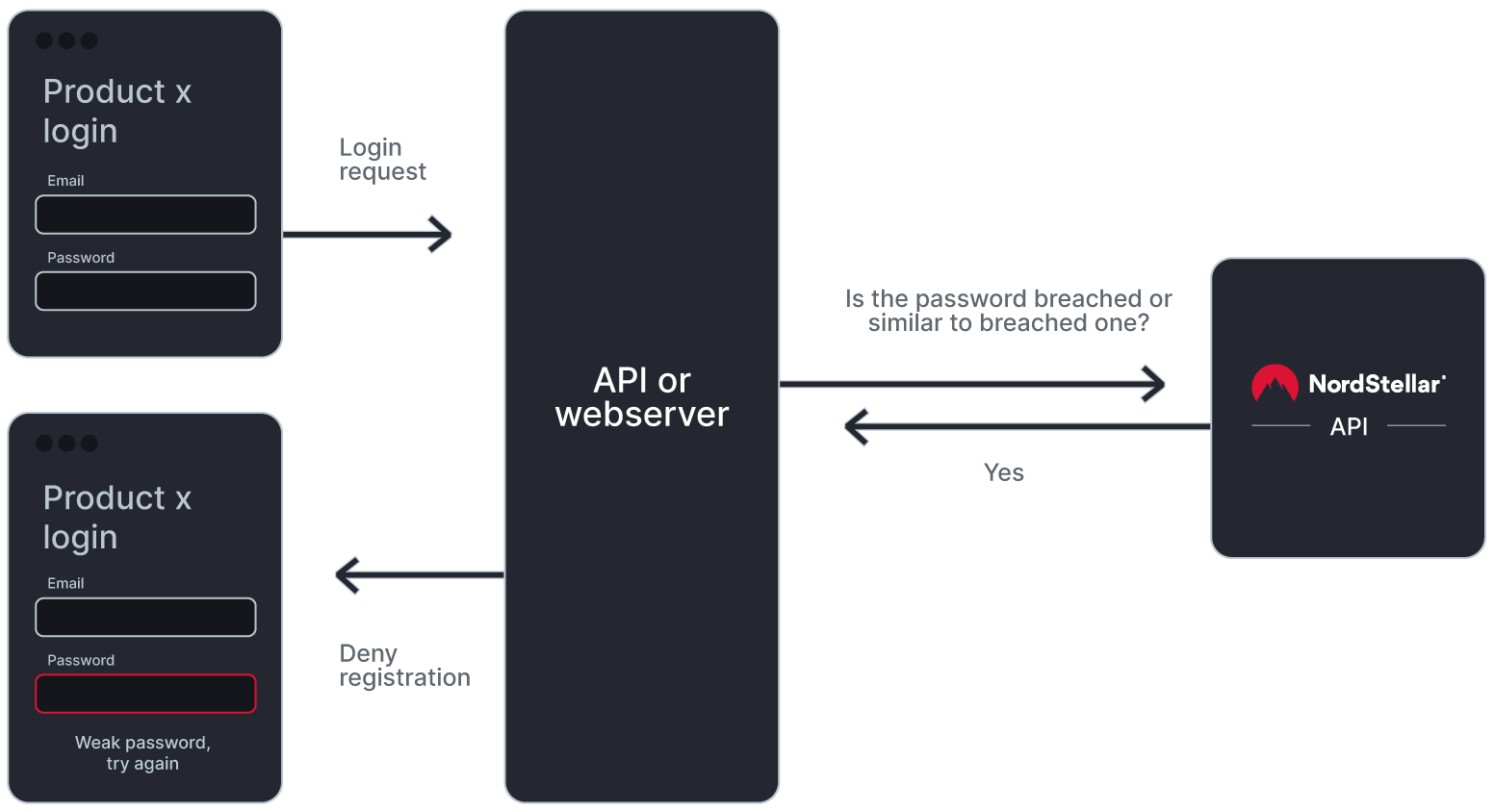
Add breach detection to your authentication workflows:
- When a user submits a login or registration form, hash their password
- Check the hash against our zero-knowledge password endpoint
- Take appropriate action based on the response:
- Block registration with compromised passwords
- Warn users during login and suggest password changes
- Force password changes for highly compromised credentials
Proactive User Base Scanning
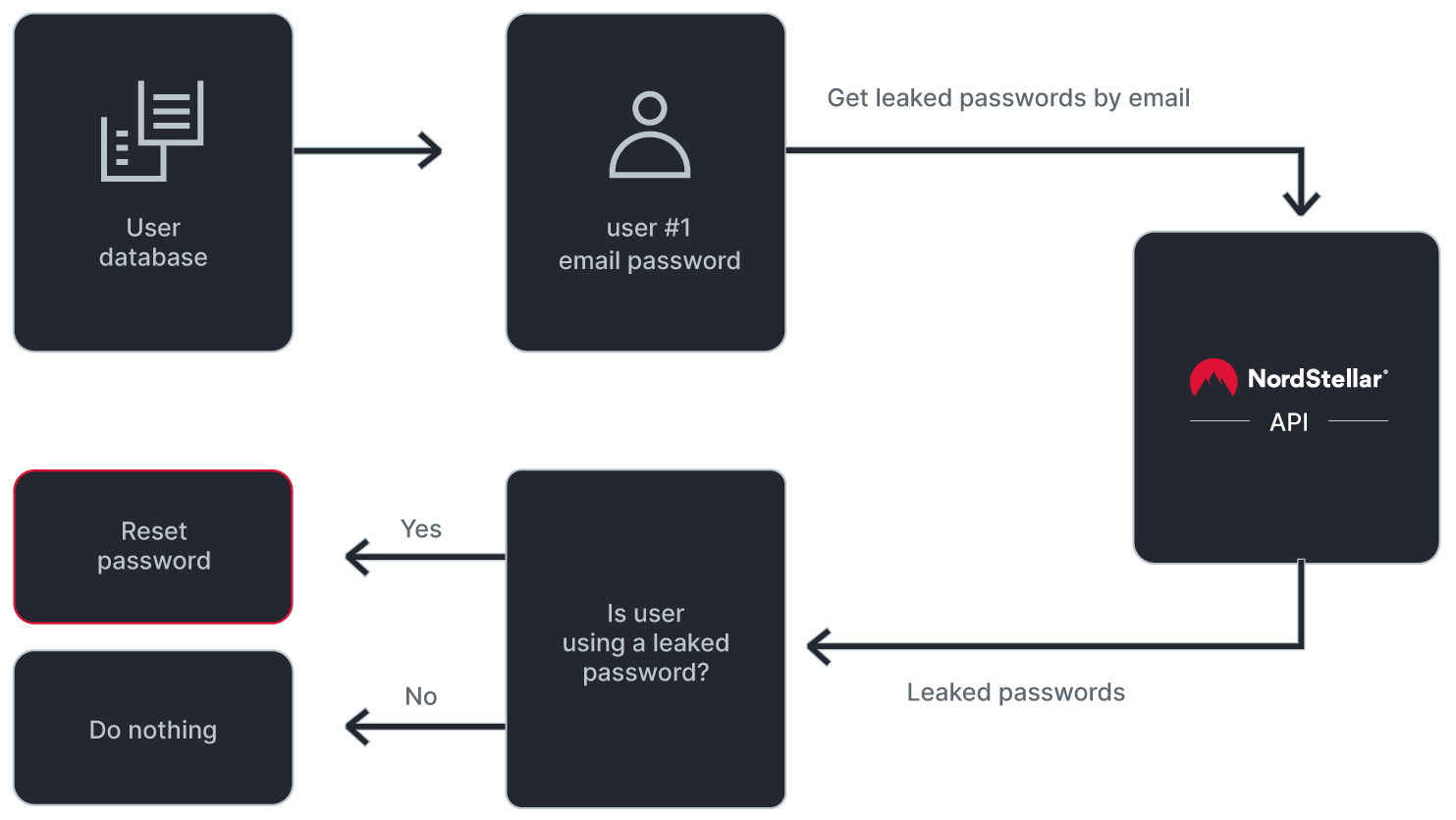
Scan for compromised credentials across your user base, utilizing either email addresses or phone numbers.
- Periodically check your user database against our API
- Identify users with compromised credentials
- Trigger password reset workflows for affected accounts
- Monitor password change adoption rates
Similar Password Engine Integration
Leverage our fuzzing capabilities to protect against password variations:
- Use the fuzzing_intensity parameter when calling our API endpoints
- Adjust the intensity based on your security requirements (0-10 scale)
- Block not just exact password matches but common variations
- Educate users about the risks of simple password modifications
Real-World Use Cases
E-commerce Platform
A major e-commerce platform implemented our account takeover prevention measures:
- They blocked 12,000 account creation attempts using compromised passwords in the first month
- They detected and prevented 3,500 unauthorized login attempts using credentials from recent breaches
- Their customer support tickets for account takeovers decreased by 78%
Financial Services
A financial services company enhanced their security posture:
- They implemented the similar password engine to block variations of compromised passwords
- They applied risk-based authentication based on breach exposure
- They detected and invalidated 450 compromised session cookies in six months
- They reduced account takeover fraud by 92% year-over-year
SaaS Provider
A software-as-a-service provider strengthened user account security:
- They integrated the zero-knowledge password API into their authentication flow
- They retroactively scanned their user base and forced resets for compromised accounts
- They implemented progressive security measures based on user risk profiles
- They dramatically reduced support costs related to account recovery and fraud
By implementing these account takeover prevention measures, organizations can significantly enhance their security posture, protect user accounts from unauthorized access, and maintain trust in their digital services.